

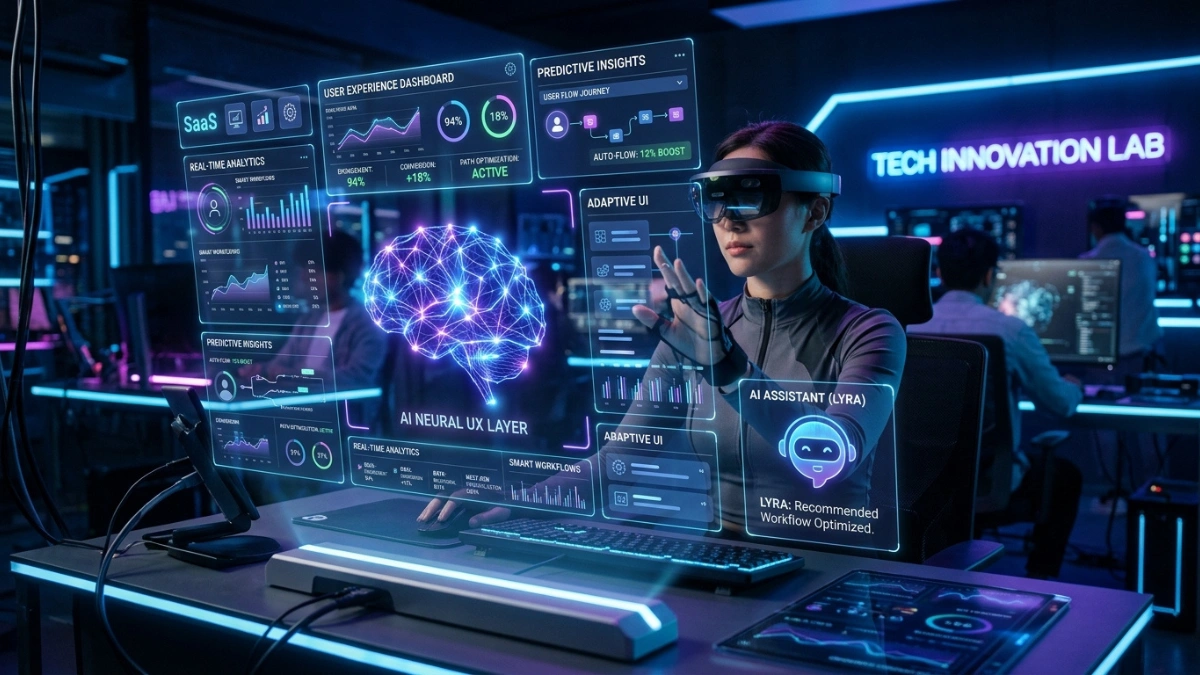
The digital world is evolving at an extraordinary pace. Every year, users become more connected, more informed, and more demanding about the experiences they receive from websites, mobile applications, SaaS platforms, and digital services. Consumers no longer compare companies only by price or features they compare them by experience.
Today, users expect products to understand them.
They expect platforms to recognize their preferences, anticipate their needs, simplify their decisions, and deliver experiences that feel natural and intelligent. This growing expectation is driving one of the most important transformations in modern technology:
AI-powered personalization is becoming the new standard for user experience (UX).
Artificial intelligence is changing how products are designed, how interfaces behave, how recommendations are generated, and how businesses interact with customers. The era of static digital experiences is rapidly disappearing. In its place, companies are building adaptive, intelligent systems that evolve continuously based on user behavior.
From Netflix and Spotify to enterprise SaaS products and eCommerce platforms, personalization is now at the center of digital product strategy.
Businesses that fail to embrace personalized experiences risk falling behind competitors that deliver smarter, faster, and more human-centered interactions.
What Is AI-Powered Personalization?
AI-powered personalization is the process of using artificial intelligence, machine learning, behavioral analytics, and predictive algorithms to tailor digital experiences for individual users.
Instead of showing the same content and workflows to every visitor, AI systems analyze user behavior and dynamically customize the experience in real time.
These systems collect and process data such as:
- Browsing behavior
- Purchase history
- Click patterns
- Device usage
- Search activity
- Interaction timing
- Session duration
- User interests
- Geographic location
- Workflow habits
- Engagement trends
Using this information, AI can create highly personalized experiences that match individual user preferences and goals.
Examples of AI-powered personalization include:
- Netflix recommending movies based on viewing history
- Spotify generating personalized playlists
- Amazon suggesting products users are likely to purchase
- YouTube adapting content feeds
- SaaS dashboards customizing workflows
- AI copilots offering contextual assistance
- Learning platforms adjusting lessons dynamically
The ultimate goal is to create experiences that feel intelligent, seamless, and uniquely tailored to each user.
The Shift From Static UX to Adaptive UX
Traditional UX design focused heavily on consistency. Designers created fixed interfaces intended to work similarly for every user.
While this model worked for many years, modern digital ecosystems have become far more complex. Users now interact with products in different ways depending on:
- Their goals
- Skill levels
- Workflows
- Context
- Devices
- Environments
- Preferences
A beginner user and an advanced user may need completely different experiences inside the same application.
Static UX often creates several problems:
- Information overload
- Irrelevant recommendations
- Complex navigation
- Generic onboarding
- Poor engagement
- Slow task completion
- Increased friction
AI-powered personalization solves these issues by introducing adaptive UX.
Adaptive UX changes interfaces dynamically based on user behavior and intent.
Instead of forcing users to adapt to software, the software adapts to the user.
This is a major transformation in how digital products are built.
Why Personalization Matters More Than Ever
Modern consumers are surrounded by digital choices. Users can switch platforms within seconds if experiences feel slow, confusing, or irrelevant.
Personalization helps businesses:
- Improve engagement
- Increase customer satisfaction
- Reduce churn
- Build loyalty
- Increase retention
- Drive conversions
- Improve productivity
- Enhance customer trust
Research consistently shows that users spend more time on platforms that provide personalized recommendations and adaptive experiences.
People naturally prefer systems that:
- Save time
- Reduce effort
- Predict needs
- Simplify decisions
- Deliver relevance
This is why personalization has become one of the most powerful competitive advantages in the technology industry.
AI Is Becoming the Operational Layer of UX
In the past, AI features were often added as secondary enhancements.
Today, AI is becoming deeply integrated into the foundation of digital products.
Modern AI systems now influence:
- Navigation
- Content delivery
- Search results
- Product recommendations
- Workflow automation
- Accessibility
- Customer support
- Security systems
- User retention strategies
- Feature discovery
- Notification systems
Many organizations are redesigning their products around AI-first experiences rather than simply adding AI tools afterward.
This shift represents the evolution from:
- Feature-based products
to - Intelligent adaptive systems
The user experience itself is becoming AI-driven.
Personalized Onboarding Is Transforming User Adoption
One of the biggest challenges for digital products has always been onboarding.
Traditional onboarding experiences often overwhelm users with:
- Too many tutorials
- Irrelevant walkthroughs
- Complex interfaces
- Generic guidance
AI personalization is transforming onboarding into a smarter and more adaptive process.
Modern systems can:
- Identify user skill levels
- Detect user intent
- Customize tutorials
- Recommend relevant features
- Skip unnecessary steps
- Adapt learning paths dynamically
For example:
- A beginner user may receive step-by-step guidance.
- An advanced user may immediately access professional workflows.
This significantly improves:
- Product adoption
- User confidence
- Activation rates
- Long-term engagement
The Rise of Predictive UX
Predictive UX refers to systems that anticipate user needs before users explicitly request something.
AI models analyze patterns and proactively assist users.
Examples include:
- Search engines predicting queries
- Email platforms suggesting replies
- Shopping apps recommending products
- SaaS tools proposing automations
- Financial apps forecasting expenses
- Streaming platforms suggesting content
Predictive UX reduces cognitive load and creates smoother experiences.
Instead of requiring constant manual interaction, AI helps users move faster and more efficiently.
Hyper-Personalization: The Next Evolution
Basic personalization is no longer enough for many industries.
The next stage is hyper-personalization.
Hyper-personalization combines:
- Real-time analytics
- Behavioral intelligence
- Context awareness
- AI predictions
- Environmental data
- Cross-platform activity
- Emotional signals
- Historical interactions
This allows products to personalize experiences at an extremely granular level.
Examples include:
- Healthcare apps adapting recommendations based on patient habits
- Fitness platforms changing workout intensity dynamically
- Educational apps adjusting teaching styles
- Banking apps predicting financial risks
- Enterprise software optimizing workflows automatically
Hyper-personalization aims to create experiences that feel uniquely crafted for every individual.
AI Personalization in eCommerce
eCommerce remains one of the largest adopters of AI-powered UX.
Modern online stores use AI for:
- Personalized recommendations
- Dynamic pricing
- Smart search
- Cart recovery
- Personalized offers
- Inventory prediction
- Customer segmentation
- AI chat support
- Purchase forecasting
Consumers increasingly expect:
- Relevant product suggestions
- Faster purchasing experiences
- Personalized discounts
- Intelligent shopping assistance
Retailers that fail to personalize experiences often struggle with lower engagement and higher abandonment rates.
AI-Powered UX in SaaS Platforms
SaaS companies are heavily investing in personalization to improve productivity and user retention.
Modern SaaS personalization includes:
- Custom dashboards
- AI copilots
- Workflow recommendations
- Context-aware automation
- Personalized analytics
- Smart notifications
- Feature usage optimization
Enterprise users now expect software to:
- Reduce repetitive tasks
- Understand work patterns
- Recommend optimizations
- Improve efficiency automatically
AI-driven SaaS experiences are becoming a major differentiator in competitive markets.
Conversational UX and AI Assistants
One of the biggest UX transformations is the rise of conversational interfaces.
AI assistants are changing how users interact with products.
Instead of navigating complex menus, users can:
- Ask questions naturally
- Request actions conversationally
- Receive contextual guidance instantly
Examples include:
- AI copilots
- Chat-based customer support
- Voice assistants
- Workflow automation bots
- Conversational search engines
This shift reduces friction and creates more intuitive digital experiences.
Conversation is becoming a core layer of UX design.
Behavioral Analytics Is Driving Smarter UX
Behavioral analytics is the engine behind AI personalization.
AI systems continuously analyze:
- Click patterns
- Scroll behavior
- Navigation flows
- Interaction timing
- Session activity
- Feature usage
- Drop-off points
- Frustration indicators
These insights help businesses understand:
- What users want
- Where users struggle
- Which features matter most
- Why users abandon workflows
Instead of relying only on surveys, businesses can now observe real behavior at scale.
This creates more accurate and data-driven UX improvements.
AI and Emotional Intelligence in UX
The future of personalization may involve emotional intelligence.
AI systems are increasingly exploring:
- Sentiment analysis
- Emotional tone detection
- Stress indicators
- Engagement signals
Future interfaces may adapt based on:
- User frustration
- Mood
- Energy levels
- Emotional context
For example:
- Customer support systems adjusting communication tone
- Learning apps adapting pace based on stress levels
- Productivity tools simplifying interfaces during overload
Emotion-aware UX may become a major trend in the next decade.
The Ethical Challenges of AI Personalization
Despite its advantages, AI personalization also raises serious ethical concerns.
Privacy Risks
Users are increasingly concerned about:
- Data collection
- Tracking systems
- Behavioral profiling
- Surveillance-like personalization
Algorithm Bias
AI systems can unintentionally create biased recommendations and unfair experiences.
Over-Personalization
Too much personalization can feel invasive and manipulative.
Filter Bubbles
Recommendation systems may limit exposure to diverse content.
Transparency Problems
Users often do not understand:
- Why recommendations appear
- How AI decisions are made
- What data is being used
Companies must balance personalization with ethical responsibility.
Explainable AI UX Is Becoming Essential
As AI becomes more powerful, users want transparency.
Explainable AI UX focuses on helping users understand:
- Why something was recommended
- How AI decisions were made
- Which data influenced results
- What personalization factors were applied
Transparent systems build:
- Trust
- User confidence
- Long-term loyalty
Future UX design will increasingly focus on explainability alongside intelligence.
AI Personalization and Accessibility
AI is also helping make digital products more inclusive.
Modern accessibility improvements include:
- Adaptive font sizing
- Voice interaction
- Real-time translation
- Personalized layouts
- Screen-reader optimization
- Cognitive accessibility support
- Gesture-based navigation
AI can dynamically adjust interfaces to meet different accessibility needs automatically.
This creates better experiences for broader user groups.
How Product Quality Is Changing
AI-driven experiences are changing how product quality is measured.
Traditional quality metrics are no longer enough.
Modern quality evaluation now includes:
- Recommendation accuracy
- AI consistency
- Personalization effectiveness
- Context awareness
- User trust
- Adaptive behavior quality
- AI explainability
- Behavioral engagement metrics
Quality engineering is evolving rapidly alongside AI-powered UX systems.
The Impact on QA and Testing Teams
Testing AI-powered personalized systems is far more complex than testing static applications.
QA teams must now validate:
- Dynamic interfaces
- Personalized workflows
- AI decision consistency
- Behavioral edge cases
- Real-time recommendations
- Adaptive UI rendering
- Algorithm fairness
- Data integrity
Traditional scripted testing alone is no longer sufficient.
Quality engineering teams increasingly use:
- AI-assisted testing
- Observability platforms
- Behavioral analytics
- Predictive monitoring
- Synthetic user simulations
The role of QA is expanding significantly in the AI era.
The Future of UX Design
The future of UX is not about designing static screens.
It is about designing intelligent ecosystems that:
- Learn continuously
- Adapt dynamically
- Predict needs
- Reduce friction
- Build trust
- Improve automatically
Future UX professionals will need skills in:
- AI collaboration
- Behavioral psychology
- Data analysis
- Ethical design
- Systems thinking
- Human-AI interaction
UX is evolving into a multidisciplinary field centered around intelligent experiences.
Final Thoughts
AI-powered personalization is no longer an experimental trend. It is rapidly becoming the foundation of modern digital experiences.
Users increasingly expect products that:
- Understand preferences
- Predict intent
- Adapt intelligently
- Simplify workflows
- Provide relevance instantly
Businesses that successfully embrace AI-driven UX will likely dominate future digital markets through stronger engagement, better retention, and improved customer satisfaction.
However, the future of personalization is not only about smarter algorithms.
The real challenge is building experiences that combine:
- Intelligence
- Transparency
- Ethics
- Accessibility
- Trust
- Human-centered design
As artificial intelligence continues to evolve, digital experiences will become more adaptive, more conversational, and more deeply integrated into everyday life.
The companies that succeed will be the ones that understand a simple but powerful truth:
The future of UX is not about designing interfaces it is about designing experiences that truly understand people.
For more Contact US