

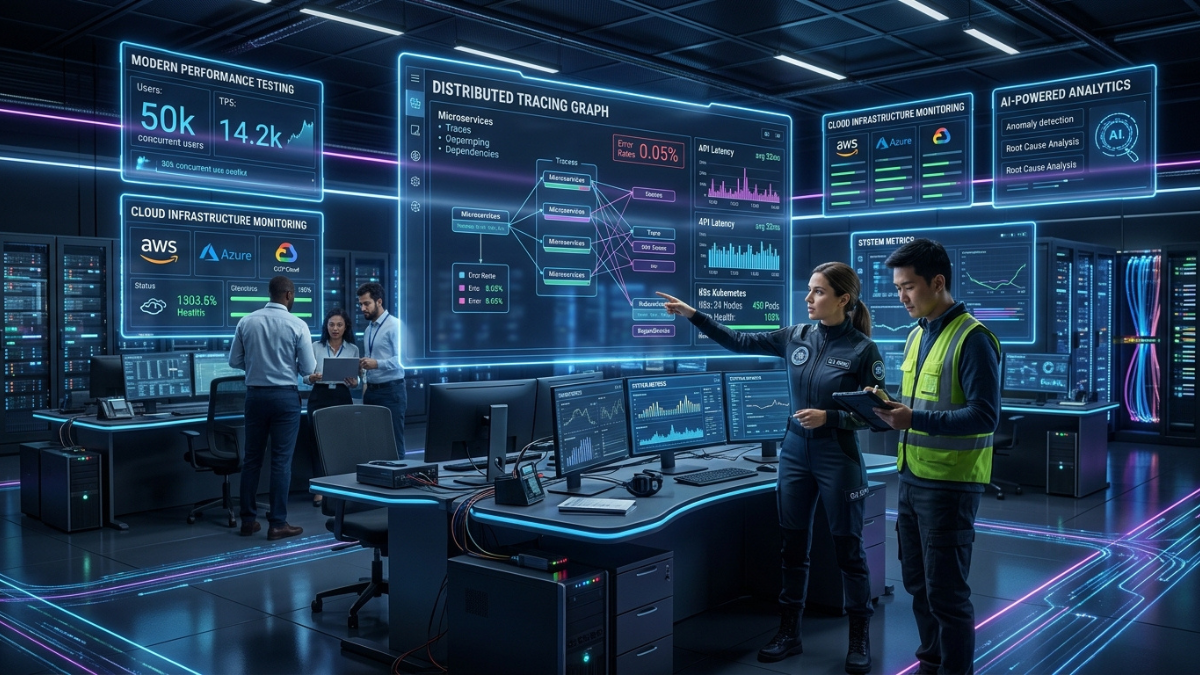
The world of software development is evolving faster than ever before. Modern applications are expected to deliver lightning-fast performance, seamless scalability, and uninterrupted availability across multiple devices and global regions. Users today have very little patience for slow-loading applications, unstable APIs, or platform outages. Even a few seconds of delay can result in lost customers, reduced revenue, and damaged brand reputation.
Because of this, performance testing has become one of the most critical areas in software quality assurance. However, traditional performance testing methods are no longer sufficient for today’s highly distributed and cloud-native architectures.
The software industry is now moving toward a new era called Observability-Driven QA.
This modern approach combines performance testing with:
- Real-time monitoring
- Distributed tracing
- Metrics analytics
- Infrastructure observability
- Log intelligence
- AI-powered diagnostics
Instead of only identifying that a system is slow, observability-driven QA helps teams understand exactly why the issue happened, where it happened, and how it impacts users.
In 2026, this transformation is reshaping the entire performance engineering landscape.
The Evolution of Performance Testing
Performance testing has existed for decades. Traditionally, QA teams used performance testing mainly to simulate user traffic and measure system behavior under load.
The primary goals included:
- Measuring response times
- Monitoring server stability
- Detecting crashes
- Identifying scalability limits
- Stress testing applications
Older performance testing workflows were heavily centered around:
- Load generation
- Concurrent virtual users
- Throughput measurement
- Server monitoring
Tools such as:
- Apache JMeter
- LoadRunner
- Gatling
became industry standards for many years.
While these tools remain valuable, modern application ecosystems have become far more complicated than the systems these testing approaches were originally designed for.
Why Traditional Performance Testing Is No Longer Enough
Today’s software systems are built using:
- Microservices
- Kubernetes
- Containers
- Cloud-native infrastructure
- Multi-cloud deployments
- Event-driven systems
- Serverless computing
- Distributed APIs
In these environments, a single user request may travel through:
- API gateways
- Authentication services
- Multiple backend microservices
- Databases
- External third-party APIs
- Messaging queues
- CDN layers
This creates enormous complexity.
Traditional performance testing may detect that:
- Response times increased
- Error rates spiked
- System throughput dropped
But it often cannot explain:
- Which service caused the slowdown
- Whether database latency increased
- Whether Kubernetes pods restarted unexpectedly
- Whether memory leaks occurred
- Whether external APIs became unstable
- Whether infrastructure auto-scaling failed
This lack of visibility creates major debugging challenges.
As applications became more distributed, organizations realized that performance testing alone was no longer enough.
This is where observability-driven QA emerged.
What Is Observability-Driven QA?
Observability-driven QA is a modern testing strategy where QA teams combine performance testing with deep system observability.
The goal is not just to measure performance but to fully understand application behavior during testing and production environments.
Observability-driven QA focuses on three major pillars:
- Metrics
- Logs
- Traces
Together, these pillars provide complete visibility into application health and system performance.
This allows teams to:
- Detect problems earlier
- Analyze root causes faster
- Improve debugging efficiency
- Prevent production outages
- Optimize scalability
- Enhance user experience
Observability is transforming QA from reactive testing into proactive system intelligence.
Understanding the Three Pillars of Observability
1. Metrics
Metrics are numerical measurements collected over time.
Examples include:
- CPU usage
- Memory consumption
- Request latency
- API throughput
- Disk utilization
- Network traffic
- Error percentages
Metrics help QA teams understand how infrastructure behaves under heavy load.
For example:
- Rising CPU usage may indicate poor scalability
- Increasing latency may signal database bottlenecks
- Memory spikes may reveal resource leaks
Metrics provide the “what” behind performance issues.
Popular monitoring platforms include:
- Prometheus
- Grafana
- Datadog
- New Relic
These tools allow teams to create real-time dashboards for performance analysis.
2. Logs
Logs provide detailed records of system events.
They help teams understand:
- Application failures
- Exceptions
- Authentication issues
- Database errors
- Deployment problems
- Infrastructure instability
During load testing, logs become incredibly valuable because they reveal hidden issues that traditional performance metrics cannot detect.
For example:
- Timeout exceptions
- Failed database connections
- API authentication failures
- Service crashes
- Queue overflows
Modern QA teams now integrate centralized log management into testing workflows.
Popular log analytics platforms include:
- Elastic Stack
- Splunk
- Graylog
Log analysis dramatically improves debugging efficiency.
3. Distributed Tracing
Distributed tracing is one of the most important innovations in modern observability.
Tracing follows requests as they move across distributed services.
For example, a single API request may pass through:
- API gateway
- Authentication service
- Payment service
- Inventory service
- Database layer
- Notification system
Distributed tracing allows teams to see:
- Which service was slow
- Which dependency failed
- Where delays occurred
- Which APIs created bottlenecks
This visibility is essential for modern microservices architectures.
Popular tracing tools include:
- Jaeger
- OpenTelemetry
- Zipkin
Tracing helps organizations solve performance problems much faster than traditional debugging methods.
Observability and Performance Testing Are Now Converging
In the past:
- QA teams performed load testing
- DevOps teams handled monitoring
- SRE teams managed infrastructure
- Developers fixed performance issues
These teams often worked separately.
Today, observability-driven QA brings everyone together using shared telemetry data.
Modern workflows now combine:
- Performance testing
- Infrastructure monitoring
- Distributed tracing
- Real-time analytics
- AI diagnostics
This creates a collaborative quality engineering ecosystem.
QA engineers are increasingly becoming:
- Performance engineers
- Reliability analysts
- Observability specialists
The role of QA is expanding rapidly.
Continuous Performance Engineering Is Becoming Standard
One of the biggest industry changes is the rise of:
Continuous Performance Engineering
Instead of testing performance only before release, organizations now test continuously throughout the development lifecycle.
Performance testing is integrated directly into:
- CI/CD pipelines
- GitHub Actions
- Jenkins workflows
- Kubernetes deployments
- DevOps automation systems
This allows teams to:
- Detect regressions earlier
- Prevent unstable deployments
- Monitor scalability continuously
- Improve release confidence
Every code change can now trigger:
- Automated load tests
- Metrics analysis
- Infrastructure validation
- Observability checks
This dramatically improves software reliability.
Cloud-Native Architectures Increased the Need for Observability
Cloud-native systems are highly dynamic.
Infrastructure can scale automatically within seconds.
Containers may:
- Restart
- Move across nodes
- Fail unexpectedly
- Scale horizontally
This creates new testing challenges.
Traditional server monitoring no longer provides enough visibility.
Observability platforms help teams track:
- Dynamic infrastructure behavior
- Container performance
- Kubernetes orchestration health
- Service mesh communication
- Network latency patterns
This is why observability has become critical for cloud-native performance testing.
AI Is Revolutionizing Observability-Driven QA
Artificial Intelligence is now entering performance engineering at a massive scale.
Modern AI-powered observability systems can:
- Detect anomalies automatically
- Predict failures
- Identify unusual traffic patterns
- Recommend scaling strategies
- Generate intelligent alerts
- Automate root cause analysis
AI dramatically reduces manual troubleshooting work.
Instead of spending hours analyzing dashboards, teams can now receive automated insights instantly.
AI-powered platforms are becoming a major trend in 2026.
The Growing Popularity of Grafana k6
One of the biggest performance testing trends today is the rise of:
Grafana k6
k6 is becoming extremely popular because it integrates naturally with modern observability ecosystems.
Key advantages include:
- JavaScript-based scripting
- Lightweight architecture
- Real-time metrics
- Cloud-native compatibility
- Grafana integration
- Kubernetes support
- CI/CD automation
Unlike older tools, k6 fits perfectly into DevOps workflows.
Many organizations are now replacing traditional testing systems with k6-based performance engineering pipelines.
Benefits of Observability-Driven QA
Faster Root Cause Analysis
Teams can immediately identify exactly where failures occur.
Better User Experience
Organizations can proactively detect slowdowns before customers are affected.
Reduced Downtime
Continuous monitoring helps prevent outages.
Improved Scalability
Teams can optimize infrastructure based on real performance insights.
Stronger Collaboration
Developers, QA engineers, and DevOps teams share the same observability data.
Higher Release Confidence
Continuous validation reduces deployment risks.
Better Production Stability
Applications become more resilient under real-world traffic conditions.
Challenges of Implementing Observability-Driven QA
Despite its benefits, implementation is not easy.
Common challenges include:
Large Volumes of Telemetry Data
Modern systems generate enormous amounts of metrics, logs, and traces.
Monitoring Costs
Observability platforms can become expensive at scale.
Skill Gaps
Many QA engineers still lack observability expertise.
Tool Complexity
Integrating multiple observability systems requires advanced engineering knowledge.
Data Noise
Too many alerts can overwhelm teams.
Organizations must build strong observability strategies to avoid these problems.
Best Practices for Observability-Driven QA
Integrate Observability Early
Monitoring should begin during development, not after deployment.
Automate Performance Testing
Integrate testing into CI/CD pipelines.
Use Realistic Test Scenarios
Simulate actual production traffic patterns.
Correlate Metrics, Logs, and Traces
Combining all three pillars provides full visibility.
Implement Smart Alerting
Avoid alert fatigue with intelligent notifications.
Monitor Production Continuously
Performance engineering should continue after release.
Future of Performance Engineering
The future of performance testing is moving toward:
- Autonomous testing systems
- AI-driven observability
- Predictive analytics
- Self-healing infrastructure
- Real-time production intelligence
- Intelligent auto-scaling
- Fully automated root cause analysis
QA teams will increasingly become:
- Reliability engineers
- Observability analysts
- Performance architects
The line between QA, DevOps, and SRE will continue to blur.
Final Thoughts
Performance testing is undergoing one of the biggest transformations in software engineering history.
Traditional load testing alone is no longer enough for today’s highly distributed, cloud-native, and microservices-driven systems.
Organizations now require:
- Full-stack visibility
- Real-time monitoring
- Distributed tracing
- AI-powered diagnostics
- Continuous observability
This is why observability-driven QA is becoming the future of performance engineering.
By combining observability with performance testing, organizations can build applications that are:
- Faster
- More scalable
- More reliable
- More resilient
- Better optimized for user experience
In 2026 and beyond, observability-driven QA will become one of the core foundations of modern quality engineering and digital reliability.
For more Contact US