

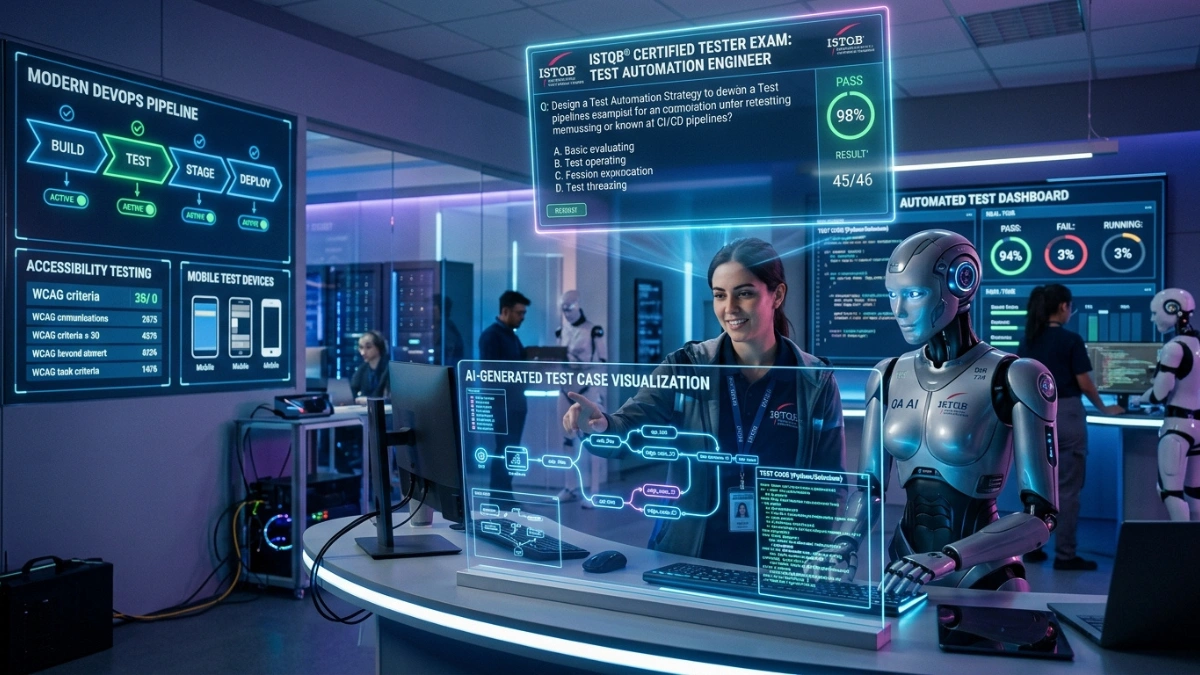
The software testing industry is witnessing one of the biggest transformations in its history. Artificial Intelligence is no longer just a futuristic concept discussed in conferences and research papers. It is now actively participating in real-world software quality engineering processes from generating automated test scripts to predicting defects and optimizing testing pipelines.
But in 2026, a new milestone shocked the QA industry:
Advanced AI models are now successfully passing ISTQB certification exams.
For many QA professionals, this news raised serious questions:
- Can AI replace software testers?
- Are QA certifications losing value?
- Will automation eliminate manual testing roles?
- What skills will testers need in the future?
- Is quality engineering entering a completely new era?
The reality is both exciting and complex. AI passing ISTQB exams does not mean software testers are becoming obsolete. Instead, it signals a dramatic shift in how testing knowledge is learned, applied, and scaled within modern software organizations.
This development represents a turning point for the entire quality assurance industry.
Understanding ISTQB and Why It Matters
The International Software Testing Qualifications Board, widely known as ISTQB, is the world’s leading software testing certification body.
Founded to standardize software testing practices globally, ISTQB created structured learning frameworks that helped define:
- Testing terminology
- QA methodologies
- Test management principles
- Defect handling processes
- Risk-based testing strategies
- Automation testing concepts
- Agile testing approaches
Today, millions of software testers worldwide hold ISTQB certifications.
For organizations, ISTQB certifications often help:
- Validate testing knowledge
- Establish common QA standards
- Improve team communication
- Build structured testing processes
- Increase hiring confidence
For testers, certifications provide:
- Career growth opportunities
- Professional credibility
- Industry-recognized qualifications
- Strong foundational QA knowledge
Because of its global influence, the idea that AI can now pass ISTQB exams is highly significant.
The Rapid Rise of AI in Software Testing
To understand why this matters, we first need to examine how quickly AI has entered the QA ecosystem.
Only a few years ago, most software testing still depended heavily on:
- Manual test execution
- Script-heavy automation
- Human-written test cases
- Static regression suites
- Traditional defect reporting
But the arrival of advanced AI systems changed everything.
Modern AI-powered QA tools can now:
- Generate test cases automatically
- Detect UI changes intelligently
- Predict unstable tests
- Analyze logs in seconds
- Suggest bug fixes
- Perform API validation
- Create automation scripts
- Detect accessibility violations
- Optimize test coverage
- Prioritize high-risk areas
This evolution has dramatically accelerated software delivery pipelines.
Organizations now expect:
- Faster releases
- Continuous testing
- Real-time quality insights
- Higher automation coverage
- Smarter testing decisions
AI became the perfect technology to support these demands.
The Research That Changed the Industry
In recent studies conducted by researchers and QA professionals, large language models were tested against ISTQB certification exams to evaluate how well AI understands software testing theory.
The results surprised even experienced QA experts.
Several AI systems:
- Passed foundational ISTQB exams
- Achieved strong scores in advanced testing concepts
- Demonstrated deep understanding of QA terminology
- Solved complex multiple-choice testing scenarios
- Applied testing methodologies accurately
The AI models showed impressive knowledge in areas such as:
- Equivalence partitioning
- Boundary value analysis
- Decision table testing
- State transition testing
- Risk-based testing
- Defect lifecycle management
- Agile testing principles
- Test planning
- Regression testing strategies
- Static testing concepts
This was not random guessing.
The AI systems displayed structured understanding of software testing methodologies that traditionally required extensive human study.
Why AI Performs So Well in Certification Exams
AI models excel in environments where:
- Patterns are consistent
- Language is structured
- Definitions are standardized
- Concepts follow logical frameworks
ISTQB exams are designed around exactly these characteristics.
The certification syllabus contains:
- Clearly defined terminology
- Process-oriented logic
- Standardized testing practices
- Predictable reasoning structures
Large language models are trained on massive datasets that include:
- QA documentation
- Testing tutorials
- Technical blogs
- Certification materials
- Software engineering textbooks
- Automation frameworks
- Industry best practices
As a result, AI becomes highly effective at recognizing testing concepts and applying them correctly in exam scenarios.
For example, AI can easily explain:
- The difference between severity and priority
- When exploratory testing is useful
- Why regression testing matters
- How risk-based testing works
- Which test design technique fits a scenario
This makes AI naturally powerful in certification-style assessments.
But Software Testing Is Far More Than Theory
Passing an ISTQB exam is impressive.
However, real-world software testing is dramatically more complicated than answering theoretical questions.
This is where many misconceptions begin.
Some headlines suggested:
“AI Can Replace Software Testers”
But this conclusion is highly misleading.
Software quality engineering involves much more than memorized knowledge.
Real QA work requires:
- Human intuition
- Critical thinking
- Creativity
- User empathy
- Business understanding
- Communication skills
- Product awareness
- Risk judgment
- Investigative thinking
These areas remain difficult for AI.
Human Testers Still Excel in Critical Areas
1. Exploratory Testing
Exploratory testing is one of the most human aspects of software quality engineering.
Unlike scripted testing, exploratory testing depends on:
- Curiosity
- Experience
- Suspicion
- Creativity
- Unpredictable thinking
Human testers naturally ask:
- “What happens if the user clicks repeatedly?”
- “What if network connectivity fails?”
- “Can this workflow confuse first-time users?”
- “What edge cases did developers overlook?”
AI struggles to reproduce this kind of instinctive exploration.
2. Understanding User Experience
Modern software quality is not just about functionality.
Today’s applications compete heavily on:
- User experience
- Accessibility
- Simplicity
- Emotional engagement
- Interface clarity
- Customer satisfaction
Human testers can sense frustration, confusion, or usability problems that AI may not recognize effectively.
For example:
- A page may technically function correctly
- But users may still find it confusing or stressful
Human perception remains essential in evaluating these experiences.
3. Business Context Awareness
In real projects, testers constantly make strategic decisions based on:
- Business priorities
- Release deadlines
- Customer impact
- Revenue risk
- Compliance requirements
AI can suggest theoretically correct testing actions but often lacks deeper understanding of:
- Organizational goals
- Stakeholder priorities
- Market pressures
- Product strategy
Human QA engineers understand these complexities far better.
4. Communication and Collaboration
Testing is not an isolated activity.
QA professionals work closely with:
- Developers
- Product managers
- UX designers
- Security teams
- DevOps engineers
- Business stakeholders
Effective testing requires:
- Negotiation
- Reporting clarity
- Collaboration
- Leadership
- Team communication
AI cannot fully replace human interaction in these areas.
The Debate Around QA Certifications Is Growing
The fact that AI can pass ISTQB exams has also triggered debate regarding the future value of certifications themselves.
Some professionals argue:
- Certifications rely too heavily on memorization
- Theory alone does not prove real-world expertise
- Practical skills matter more than exam scores
- Modern QA requires broader engineering capabilities
Others strongly defend certifications because they:
- Create common industry standards
- Build foundational testing knowledge
- Improve process consistency
- Help beginners enter the QA field
- Standardize terminology globally
Both sides raise valid points.
The software testing industry is now rethinking how certifications should evolve in the AI era.
ISTQB Is Adapting to the AI Models Revolution
The International Software Testing Qualifications Board itself is evolving to address modern quality engineering trends.
New certification areas increasingly include:
- AI-assisted testing
- Continuous testing
- DevOps integration
- Test automation engineering
- Shift-left testing
- Quality engineering practices
- Machine learning validation
- AI governance
- Cloud testing
- Security testing
Future certifications may focus more on:
- Real-world problem solving
- Strategic quality decisions
- Human + AI Models collaboration
- Advanced automation architecture
- Critical thinking skills
This evolution reflects how rapidly the QA profession is changing.
The Emergence of AI-Augmented Testers
Instead of replacing QA professionals, AI Models is creating a new category of software tester:
The AI-Augmented Quality Engineer
These professionals use AI Models as a productivity accelerator.
Future testers will increasingly rely on AI to:
- Generate test scenarios
- Improve documentation
- Create automation scripts
- Analyze failures
- Predict risks
- Optimize regression suites
- Improve test coverage
This allows testers to spend more time on:
- Strategic testing
- User experience validation
- Product quality analysis
- Risk assessment
- Exploratory investigation
The role of QA is becoming more strategic than ever before.
How Enterprises Are Responding
Large enterprises are already transforming their QA strategies because of AI Models advancements.
Organizations are investing heavily in:
- Intelligent automation
- AI-powered test platforms
- Continuous testing systems
- Predictive quality analytics
- Self-healing automation frameworks
- AI-driven observability tools
Businesses now want QA teams that can:
- Collaborate with AI systems
- Manage automation intelligently
- Deliver faster releases
- Improve software reliability
- Reduce production failures
This demand is reshaping hiring trends across the software industry.
Skills Future Testers Must Develop
As AI Models continues evolving, successful testers will need stronger expertise in areas that machines struggle to replicate.
The most valuable future QA skills include:
Technical Skills
- Automation engineering
- API testing
- CI/CD integration
- Cloud testing
- Security testing
- Performance engineering
Human-Centered Skills
- Critical thinking
- Exploratory testing
- Communication
- Product analysis
- UX evaluation
- Risk management
AI Models Collaboration Skills
- Prompt engineering
- AI-assisted testing workflows
- Validation of AI-generated outputs
- AI governance understanding
The future tester will combine technical expertise with strategic thinking.
AI Models Will Transform QA Careers Not Destroy Them
Historically, every major technological advancement created fear within industries.
When automation testing became popular, many believed manual testing would disappear.
But instead:
- QA evolved
- Automation engineers emerged
- Quality engineering expanded
- New opportunities appeared
The same pattern is happening with AI Models.
AI Models will eliminate repetitive testing activities.
But it will also create demand for:
- smarter testers
- strategic QA leaders
- AI validation specialists
- quality engineering architects
The profession is transforming not disappearing.
The Bigger Shift: From QA to Quality Engineering
The most important takeaway is that software testing itself is evolving into something much larger.
Traditional QA focused heavily on:
- Finding bugs
- Executing test cases
- Reporting defects
Modern quality engineering focuses on:
- Preventing failures early
- Improving customer experience
- Enabling continuous delivery
- Managing release risk
- Optimizing product quality continuously
AI Models is accelerating this transformation dramatically.
The future of testing will be:
- AI-assisted
- highly automated
- continuous
- predictive
- strategic
- user-focused
Final Thoughts
AI Models passing ISTQB exams is not the end of software testing careers.
It is a signal that the QA industry is entering a completely new phase.
Artificial Intelligence can now:
- understand testing theory
- answer certification questions
- assist with automation
- optimize QA workflows
But software quality is still deeply human.
Great testers do more than memorize concepts.
They:
- understand users
- analyze business risks
- investigate unexpected behavior
- improve customer experiences
- think creatively
- make strategic quality decisions
The future belongs to QA professionals who can successfully combine:
- human intelligence
- engineering expertise
- AI Models collaboration
- strategic thinking
Software testing is not dying.
It is evolving into one of the most advanced and intelligent disciplines in modern software engineering.
For more Contact US