

The world of software testing is evolving rapidly, and among the modern automation tools, Playwright has emerged as a game-changer for enterprises. What started as a relatively new entrant in the automation ecosystem has now become one of the most trusted and widely adopted frameworks across industries.
As businesses move toward digital transformation, agile development, and DevOps-driven delivery models, traditional testing tools like Selenium are no longer sufficient on their own. They often require heavy configurations, third-party integrations, and complex maintenance. The tool addresses these challenges by offering a modern, all-in-one testing solution that aligns perfectly with today’s fast-paced development environments.
The Rise of Playwright in the Modern QA Landscape
Over the past few years, enterprises have significantly shifted their focus toward speed, scalability, and reliability in testing. Applications today are more dynamic than ever, built using frameworks like React, Angular, and Vue, which demand advanced automation capabilities.
The tool was built specifically to handle these complexities. Its architecture supports:
- Modern JavaScript-heavy applications
- Real-time UI updates
- Complex DOM structures
This makes it highly suitable for testing Single Page Applications (SPAs) and microservices-based systems.
Another major factor contributing to its rise is the strong backing of Microsoft, which ensures continuous innovation, updates, and enterprise-grade reliability.
Key Drivers Behind Rapid Enterprise Adoption
1. Unified Cross-Browser Testing Experience
One of Playwright’s strongest advantages is its ability to run tests across multiple browsers using a single codebase.
- Chromium (Chrome, Edge)
- Firefox
- WebKit (Safari)
Unlike Selenium, which often requires additional setup for each browser, The tool simplifies the process significantly.
This leads to faster test creation and execution, saving both time and resources.
2. Auto-Waiting: A Solution to Flaky Tests
Flaky tests are a major pain point for QA teams. The tool tackles this with its intelligent auto-waiting mechanism, ensuring that elements are ready before any interaction.
Benefits include:
- Reduced test failures
- Increased reliability
- Less debugging effort
This feature alone has made Playwright highly attractive to enterprises dealing with large automation suites.
3. Built-In Parallel Execution for Speed
In enterprise environments, where thousands of test cases need to be executed, speed becomes critical.
Playwright supports:
- Parallel test execution
- Distributed test runs
- Faster feedback cycles
This allows organizations to shorten release cycles and deliver features more quickly.
4. Rich API & Network Control Capabilities
Playwright goes beyond UI testing by offering powerful network interception and API testing capabilities.
Teams can:
- Mock API responses
- Simulate network failures
- Test edge cases efficiently
This enables end-to-end testing coverage without relying heavily on external tools.
5. Developer-Friendly Approach
Playwright is designed with developers in mind. It supports:
- JavaScript
- TypeScript
- Python
- Java
- .NET
This multi-language support ensures that teams can work in their preferred environments, improving collaboration between developers and QA engineers.
Playwright in CI/CD and DevOps Pipelines
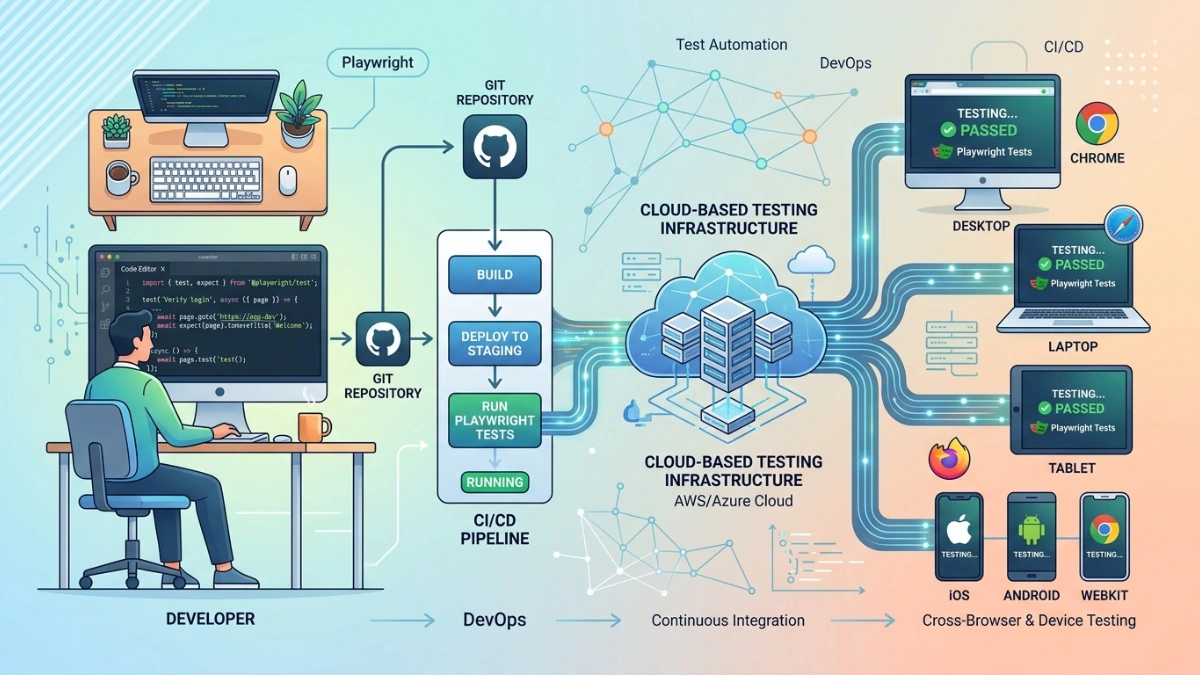
Modern enterprises are embracing continuous integration and continuous delivery (CI/CD) to stay competitive. The tool integrates seamlessly into these pipelines, making it a key component of DevOps strategies.
Common integrations include:
- Jenkins
- GitHub Actions
- GitLab CI
With Playwright, organizations can:
- Run automated tests on every commit
- Detect bugs early
- Maintain consistent quality
This shift toward continuous testing is one of the biggest reasons behind Playwright’s growing adoption.
Cloud & Scalable Testing with Playwright
Enterprises are increasingly moving toward cloud-based infrastructures. Playwright supports this transition by enabling:
- Cross-browser testing on cloud platforms
- Execution on real devices
- Scalable infrastructure for large test suites
When integrated with cloud providers, The tool helps teams achieve:
- Faster execution
- Global test coverage
- Reduced infrastructure costs
Integration with AI & Future Testing Trends
Another major factor contributing to The tool’s rise is its compatibility with AI-driven testing tools. Modern QA teams are leveraging AI for:
- Self-healing test scripts
- Smart element detection
- Automatic test generation
Playwright’s flexible architecture makes it easy to integrate with these tools, positioning it as a future-ready automation framework.
Real-World Enterprise Use Cases
E-commerce Platforms
Large e-commerce companies use Playwright to test:
- Product pages
- Checkout flows
- Payment integrations
Banking & Fintech Applications
Playwright helps ensure:
- Secure transactions
- Accurate data processing
- Compliance with regulations
SaaS Products
SaaS companies rely on Playwright for:
- Regression testing
- UI validation
- Continuous deployment
Playwright vs Selenium: Enterprise Perspective
While Selenium remains a strong player, The tool offers several advantages:
| Feature | Playwright | Selenium |
|---|---|---|
| Setup | Simple & fast | Complex |
| Speed | High | Moderate |
| Flakiness | Low | Higher |
| Built-in Features | Extensive | Limited |
| Modern App Support | Excellent | Moderate |
Many enterprises are now adopting a hybrid approach, using The tool for modern applications and Selenium for legacy systems.
Challenges & Considerations
Despite its advantages, The tool is not without challenges:
- Learning curve for teams new to modern frameworks
- Smaller ecosystem compared to Selenium
- Limited support for legacy systems
However, these challenges are gradually diminishing as the community grows and more resources become available.
Future Outlook: What’s Next for Playwright?
The future of Playwright looks extremely promising. Key trends to watch include:
- Increased enterprise adoption
- Deeper AI integration
- Expansion of low-code automation tools
- Enhanced reporting and analytics features
As software development continues to evolve, Playwright is expected to play a central role in shaping the future of test automation.
Conclusion
Playwright’s rapid growth is a reflection of the changing demands of the software industry. Enterprises today require tools that are fast, reliable, scalable, and easy to integrate, and The tool delivers on all these fronts.
With its modern architecture, powerful features, and strong industry backing, The tool is not just an alternative to traditional tools it is becoming the new standard for automation testing.
Organizations that embrace Playwright are better positioned to:
- Deliver high-quality software
- Accelerate release cycles
- Stay competitive in a digital-first world
For more Contact US