

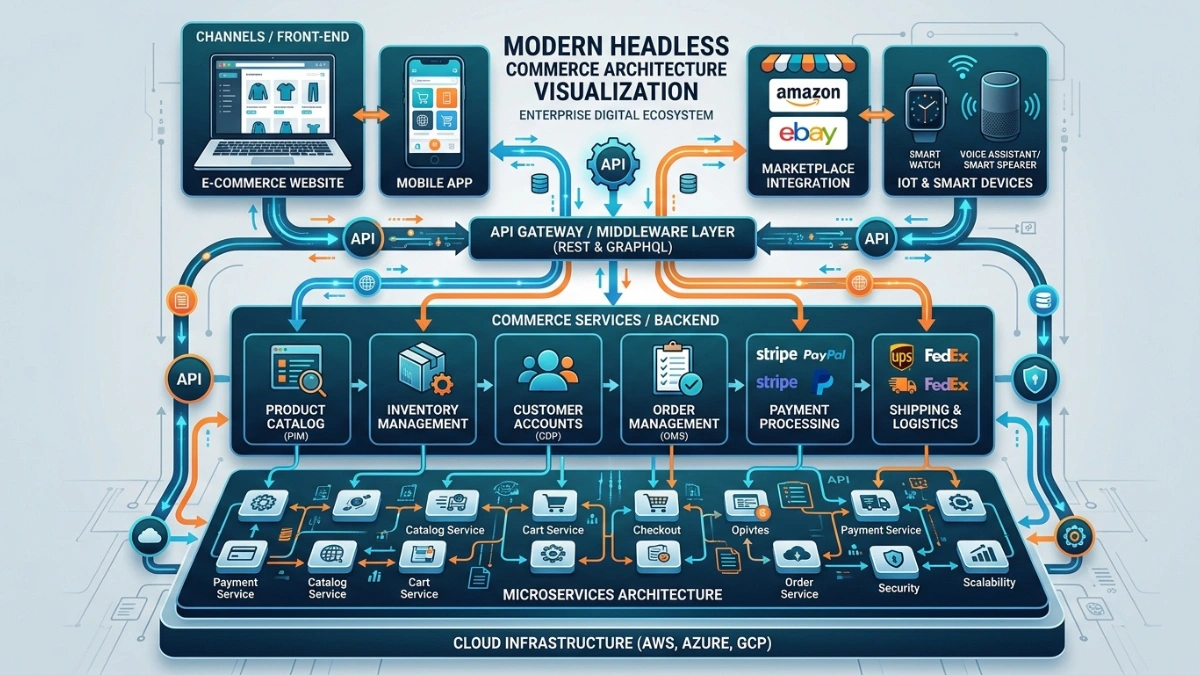
The e-commerce industry has undergone a dramatic transformation over the past decade. What was once a relatively simple online storefront connected to a database has evolved into a sophisticated ecosystem of interconnected services, cloud platforms, mobile applications, payment gateways, recommendation engines, inventory systems, logistics providers, and third-party integrations.
In 2026, a typical e-commerce transaction involves dozens of backend interactions occurring within seconds. When a customer searches for a product, adds it to a cart, applies a coupon, selects a shipping method, completes payment, and receives an order confirmation, numerous APIs work together behind the scenes to deliver a seamless shopping experience.
As businesses continue adopting headless commerce, microservices, cloud-native architectures, composable commerce, and omnichannel strategies, the importance of APIs has grown exponentially. APIs have become the backbone of modern e-commerce operations.
This architectural evolution has fundamentally changed how quality assurance teams approach testing.
Traditional UI-centric testing strategies are no longer sufficient to ensure software quality. Instead, organizations are increasingly adopting API-first testing approaches that prioritize validating backend services before focusing on user interface testing.
API-first testing is no longer viewed as a specialized testing technique it is becoming the industry standard for modern e-commerce platforms.
This shift is helping organizations achieve faster releases, better software quality, improved customer experiences, stronger security, and more reliable digital commerce ecosystems.
Understanding API-First Testing
API-first testing is a testing methodology where application programming interfaces (APIs) are tested extensively before user interface validation begins.
Rather than relying solely on front-end interactions to verify business functionality, QA teams directly test the underlying services that power the application.
The objective is to ensure that:
- Business rules function correctly
- Data is processed accurately
- Services communicate properly
- Integrations remain stable
- Performance requirements are met
- Security controls are enforced
- Customer workflows operate as expected
Because APIs sit at the core of modern e-commerce systems, validating them early enables organizations to detect and resolve defects before they reach production.
This approach aligns perfectly with agile development methodologies and CI/CD pipelines, where rapid feedback is essential.
The Evolution of E-commerce Architecture
To understand why API-first testing has become so important, it is necessary to examine how e-commerce technology has evolved.
Traditional Monolithic Platforms
Historically, e-commerce platforms were built as monolithic applications.
In these systems:
- Frontend and backend were tightly coupled.
- Business logic existed within a single codebase.
- Database interactions were centralized.
- Deployments occurred infrequently.
Testing primarily focused on the user interface because most functionality was contained within the same application.
While this approach worked for simpler online stores, it struggled to support modern business requirements.
The Rise of Microservices
As online businesses expanded, monolithic systems became difficult to scale and maintain.
Organizations began breaking applications into smaller independent services.
Examples include:
- Product Catalog Service
- Inventory Service
- Customer Service
- Cart Service
- Checkout Service
- Payment Service
- Recommendation Service
- Shipping Service
- Notification Service
Each service communicates through APIs.
As a result, the reliability of the entire platform depends on the quality of these API interactions.
Headless Commerce Revolution
One of the biggest technology trends reshaping e-commerce is headless commerce.
Headless commerce separates the frontend presentation layer from backend commerce functionality.
This allows businesses to create experiences across:
- Websites
- Mobile applications
- Smart devices
- Kiosks
- Social commerce platforms
- Marketplaces
- Voice assistants
Every channel consumes data through APIs.
If APIs fail, every customer touchpoint is affected.
This reality has made API testing a business-critical activity.
Why APIs Are the Heart of Modern E-commerce
Every customer action on an online store triggers multiple API calls.
Consider a simple product purchase journey.
Product Search
The search API retrieves product listings, pricing, inventory information, images, ratings, and availability.
Product Detail Page
Additional APIs load specifications, reviews, recommendations, and promotions.
Shopping Cart
Cart APIs manage:
- Product additions
- Quantity updates
- Cart persistence
- Price calculations
Checkout Process
Checkout APIs coordinate:
- Customer authentication
- Address validation
- Tax calculation
- Shipping estimates
Payment Processing
Payment APIs communicate with:
- Credit card processors
- Digital wallets
- Banking systems
- Fraud detection services
Order Management
Order APIs create records, update statuses, and trigger fulfillment workflows.
A failure in any of these APIs can result in:
- Lost sales
- Customer frustration
- Revenue loss
- Brand damage
This explains why API quality has become a strategic priority.
Why UI Testing Alone Is No Longer Enough
For many years, organizations relied heavily on UI automation.
While UI testing remains important, it presents several limitations.
Slow Execution
UI tests often require:
- Browser launches
- Page rendering
- Element identification
- User interaction simulation
This increases execution time.
API tests execute significantly faster.
Fragile Maintenance
UI tests frequently break due to:
- Design updates
- Layout modifications
- CSS changes
- Minor UI adjustments
API tests are generally more stable.
Limited Coverage
Many backend scenarios cannot be effectively tested through the UI.
Examples include:
- Data validation
- Error handling
- Service failures
- Integration responses
API testing provides deeper visibility into system behavior.
Higher Costs
Maintaining large UI automation suites can be expensive.
API automation often delivers greater testing coverage with lower maintenance effort.
Major Benefits of API-First Testing
1. Earlier Defect Detection
One of the biggest advantages of API-first testing is the ability to identify defects early in the development lifecycle.
Examples include:
- Incorrect business rules
- Pricing errors
- Tax calculation issues
- Inventory synchronization failures
- Authentication problems
Fixing defects earlier dramatically reduces costs.
Industry research consistently shows that defects discovered during development are significantly cheaper to resolve than those found in production.
2. Faster Development Cycles
Modern e-commerce companies release updates continuously.
Some platforms deploy changes dozens of times per day.
API testing enables:
- Rapid feedback
- Faster debugging
- Parallel development
- Continuous quality validation
Development teams can move faster without sacrificing quality.
3. Better Test Coverage
API testing allows organizations to validate hundreds of business scenarios.
Coverage areas include:
- Positive test cases
- Negative test cases
- Boundary conditions
- Data validation
- Error responses
- Integration workflows
This provides much broader validation than UI testing alone.
4. Enhanced Reliability
Stable APIs create stable applications.
By ensuring backend services operate correctly, organizations reduce:
- Production incidents
- Service outages
- Customer complaints
- Failed transactions
Reliable APIs translate directly into better customer experiences.
5. Improved Performance Testing
Performance issues can severely impact e-commerce revenue.
Research consistently shows that even small delays in page load times can reduce conversion rates.
API performance testing measures:
- Response times
- Throughput
- Scalability
- Concurrent requests
- Resource utilization
This helps organizations identify bottlenecks before peak traffic events.
Critical Areas of E-commerce API Testing
Product Catalog APIs
Product information drives purchasing decisions.
Testing ensures:
- Accurate product data
- Correct pricing
- Proper categorization
- Search functionality
- Inventory visibility
Errors in product data can directly impact sales.
Inventory APIs
Inventory synchronization is critical.
Testing verifies:
- Real-time stock updates
- Inventory reservations
- Warehouse synchronization
- Overselling prevention
Inventory failures often result in poor customer experiences.
Shopping Cart APIs
Cart functionality directly affects conversion rates.
Testing includes:
- Product additions
- Product removal
- Quantity modifications
- Coupon applications
- Tax calculations
A broken cart can immediately reduce revenue.
Checkout APIs
Checkout remains one of the most important customer journeys.
Testing validates:
- Address verification
- Shipping calculations
- Tax determination
- Promotional discounts
- Order creation
Smooth checkout experiences improve conversion rates.
Payment APIs
Payment processing is among the most sensitive components of an e-commerce platform.
Testing verifies:
- Successful payments
- Failed transactions
- Refund processing
- Chargebacks
- Fraud prevention
- Multi-currency support
Reliable payment systems build customer trust.
Customer APIs
Customer-related testing covers:
- Registration
- Authentication
- Password management
- Account updates
- Loyalty programs
Account-related failures can negatively impact customer retention.
Security Testing Through APIs
Cybersecurity threats continue to grow in sophistication.
E-commerce platforms store valuable customer information, making them attractive targets.
API security testing helps identify vulnerabilities such as:
Authentication Weaknesses
Verifying secure login mechanisms.
Authorization Failures
Ensuring users access only permitted resources.
Data Exposure
Preventing leakage of sensitive information.
Injection Attacks
Protecting against SQL injection and similar threats.
Rate Limiting Issues
Preventing abuse and denial-of-service attacks.
Session Vulnerabilities
Ensuring secure session management.
API security testing has become a mandatory component of modern QA strategies.
API Testing in CI/CD Pipelines
Continuous delivery depends on automated quality validation.
Modern CI/CD workflows often include:
Step 1
Developer commits code.
Step 2
Automated build process starts.
Step 3
API tests execute automatically.
Step 4
Results are analyzed.
Step 5
Deployment proceeds only if quality gates pass.
This process significantly reduces production defects.
Organizations adopting API-first testing often experience faster and safer deployments.
The Role of Automation in API Testing
Automation is central to API-first strategies.
Automated API tests provide:
- Immediate feedback
- Consistent execution
- High scalability
- Reduced manual effort
Teams can run thousands of tests in minutes.
This level of efficiency is impossible with manual testing alone.
Popular API Testing Tools in 2026
Leading QA teams use a variety of tools.
Postman
Industry-standard platform for API development and testing.
REST Assured
Popular Java framework for API automation.
Playwright
Increasingly used for both UI and API testing.
Karate Framework
BDD-style API automation framework.
SoapUI
Widely used for REST and SOAP service validation.
JMeter
Performance and load testing solution.
K6
Cloud-native performance testing platform.
Apache Bench
Useful for lightweight API performance checks.
Challenges of API-First Testing
Despite its benefits, organizations face several challenges.
Complex Architectures
Microservices create complicated dependency chains.
Frequent Updates
APIs evolve rapidly.
Maintaining test suites requires ongoing effort.
Test Data Management
Reliable testing depends on accurate data.
Environment Stability
Multiple services increase environmental complexity.
Security Requirements
Compliance standards continue to evolve.
Organizations must continuously adapt their testing practices.
Future Trends in E-commerce API Testing
Several trends are shaping the future.
Contract Testing
Ensuring service compatibility across teams.
Observability-Driven Testing
Leveraging production telemetry for quality insights.
Shift-Left Quality Engineering
Moving testing earlier in development.
Shift-Right Testing
Validating behavior in production environments.
Cloud-Native Testing
Supporting distributed architectures.
Continuous Quality Engineering
Embedding quality throughout the software lifecycle.
Conclusion
API-first testing has emerged as one of the most important quality assurance strategies in modern e-commerce.
As organizations embrace headless commerce, composable architectures, microservices, and omnichannel retail experiences, APIs have become the foundation of every customer interaction.
Testing these APIs early and continuously provides substantial benefits, including faster releases, improved reliability, stronger security, better performance, and enhanced customer satisfaction.
The future of e-commerce is increasingly API-driven, and successful organizations will be those that invest in comprehensive API-first testing strategies. In 2026 and beyond, API testing is no longer simply a technical best practice it is a business necessity that directly influences customer experience, operational efficiency, and competitive advantage.
For more Contact US