

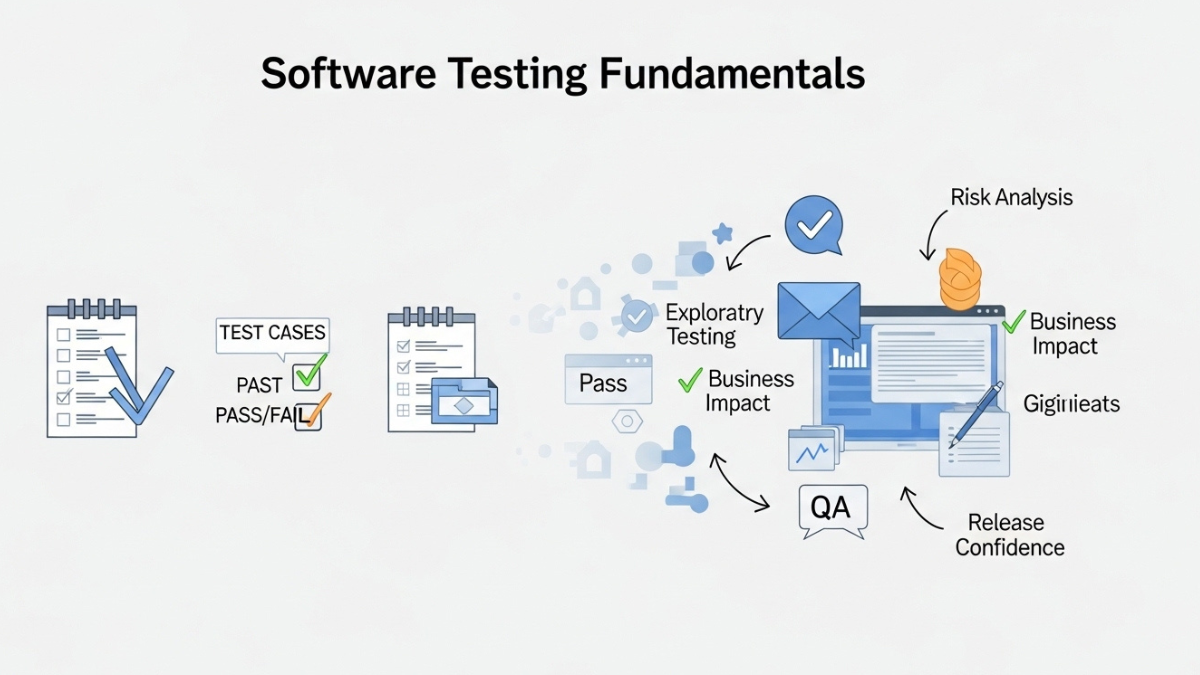
For years, software testing fundamentals were treated as fixed truths. Test cases, expected vs actual results, defect tracking, and coverage metrics formed the backbone of QA education and practice. These principles were taught, documented, certified, and repeated across organizations.
And yet, without much noise or announcement, those fundamentals have changed.
Not dramatically. Not overnight. But decisively.
Today’s most effective QA teams are still using “fundamentals” just not in the way they were originally defined. The shift has been quiet, driven by real-world delivery pressure, continuous deployment, business risk, and the limits of automation.
This article explores how software testing fundamentals have evolved, why many teams haven’t noticed the change, and what modern testers must understand to remain relevant.
Table of Contents
- Introduction: Fundamentals Don’t Disappear They Evolve
- From Testing at the End to Designing for Quality
- Coverage Is No Longer the Primary Goal
- Risk-Based Thinking Becomes a Core Fundamental
- Expected vs Actual Is No Longer Enough
- Exploratory Testing Moves from Optional to Essential
- Test Cases Lose Their Central Role
- Manual vs Automation Stops Being a Fundamental Debate
- Quality Expands Beyond Defects
- Testing Becomes a Business-Facing Discipline
- Why Many Teams Missed This Shift
- What Modern Testing Fundamentals Look Like Today
- Conclusion: The New Foundation of Software Testing
1. Introduction: Fundamentals Don’t Disappear They Evolve
When people hear “fundamentals,” they assume stability. Something foundational is expected to remain unchanged.
But in software testing, fundamentals are not laws of physics. They are working principles, shaped by how software is built, delivered, and consumed.
As delivery models shifted from waterfall to agile, from releases to continuous deployment testing fundamentals adapted. The problem is not that teams rejected old fundamentals. It’s that many continue to apply them without realizing the context has changed.
2. From Testing at the End to Designing for Quality
One of the quietest but most impactful shifts is where testing begins.
Traditional fundamentals assumed:
- Requirements are finalized
- Code is written
- Testing validates the output
Modern fundamentals assume:
- Quality is designed before development
- Testability is a design concern
- QA contributes during requirement discovery
Testing now starts with:
- Clarifying acceptance criteria
- Identifying risk early
- Challenging ambiguous requirements
Testing is no longer an activity performed after development.
It is a preventive discipline embedded into design.
3. Coverage Is No Longer the Primary Goal
Classic testing education emphasized coverage:
- Functional coverage
- Code coverage
- Requirement coverage
Coverage was treated as a proxy for quality.
Today, experienced teams understand a hard truth:
High coverage does not guarantee low risk.
Modern testing fundamentals prioritize:
- Critical path validation
- Business-impact scenarios
- Failure consequences
The question has shifted from:
“Did we test everything?”
To:
“Did we test what matters most?”
Coverage still exists but it is no longer the primary success criterion.
4. Risk-Based Thinking Becomes a Core Fundamental
What used to be considered an “advanced testing technique” is now foundational: risk-based testing.
Modern testing fundamentals now include:
- Identifying high-risk features early
- Prioritizing tests based on impact, not effort
- Understanding failure consequences
- Aligning testing depth with business exposure
This change reflects reality. Teams no longer have time to test everything equally. The fundamental skill is knowing what not to test deeply.
Risk awareness has become a baseline expectation, not a specialization.
5. Expected vs Actual Is No Longer Enough
Traditional definitions of testing focused on a simple comparison:
Expected result vs actual result
While still relevant, this is no longer sufficient.
Modern testing evaluates:
- Whether behavior aligns with user intent
- Whether logic makes business sense
- Whether workflows feel usable and trustworthy
- Whether the system behaves reasonably under uncertainty
A system can meet documented expectations and still fail users.
This has expanded testing fundamentals from verification to validation of meaning and intent.
6. Exploratory Testing Moves from Optional to Essential
Exploratory testing was once treated as informal or secondary.
Today, it is recognized as a core testing capability.
Why?
- Requirements are often incomplete
- Systems are complex and interconnected
- The most damaging defects are unpredictable
Exploratory testing allows testers to:
- Learn the system dynamically
- Follow risk signals
- Discover unknown failure modes
Modern fundamentals now recognize that thinking is as important as executing.
7. Test Cases Lose Their Central Role
In traditional QA, test cases were the primary artifact. Success was often measured by:
- Number of test cases written
- Number executed
- Pass/fail ratios
Today, test cases are increasingly seen as supporting artifacts, not the end goal.
The real outputs of modern testing are:
- Risk insight
- Quality assessment
- Release confidence
- Decision support
Test cases still exist but they no longer define the value of testing.
8. Manual vs Automation Stops Being a Fundamental Debate
Older testing fundamentals framed manual and automation testing as opposing approaches.
Modern fundamentals reject this framing entirely.
Instead, they emphasize:
- Human judgment for ambiguity, UX, and risk
- Automation for repeatability and regression
- Manual testing informing what should be automated
- Automation freeing humans to think more deeply
The fundamental question is no longer manual or automation.
It is where each adds the most value.
9. Quality Expands Beyond Defects
Another quiet but critical shift is how quality itself is defined.
Traditional testing equated quality with:
- Defect absence
Modern testing fundamentals include validation of:
- Usability
- Accessibility
- Performance perception
- Reliability
- Trust and confidence
A product can be defect-free and still be unacceptable.
This redefinition has expanded testing responsibilities beyond functional correctness into experience and impact.
10. Testing Becomes a Business-Facing Discipline
One of the most significant changes in testing fundamentals is who testing is for.
Historically, testing served:
- Developers
- Engineering teams
Today, testing serves:
- Product owners
- Business leaders
- Compliance stakeholders
- Customers
Modern testers are expected to:
- Communicate risk in business terms
- Explain impact, not just issues
- Support release decisions
This is why organizations such as QA Ninjas Technologies align testing fundamentals with business risk, delivery confidence, and real-world impact, not just technical validation.
11. Why Many Teams Missed This Shift
The shift in fundamentals happened quietly for three reasons:
- Certifications Lag Reality
Formal curricula often update slower than industry practice. - Old Metrics Still Exist
Teams still track test cases and coverage, masking deeper change. - The Language Didn’t Change The Meaning Did
Teams still say “testing,” but the expectations are radically different.
As a result, many testers follow old practices while believing they are modern.
12. What Modern Testing Fundamentals Look Like Today
Today’s true testing fundamentals include:
- Quality built into design
- Risk-based prioritization
- Validation of intent and impact
- Exploratory thinking
- Human + automation collaboration
- Business-aligned communication
These fundamentals are not new theories. They are responses to modern delivery reality.
Teams that adopt them naturally scale.
Teams that don’t struggle no matter how many tools they adopt.
13. Conclusion: The New Foundation of Software Testing
Software testing fundamentals haven’t been replaced.
They’ve been redefined by necessity.
The shift wasn’t announced.
There was no breaking change notice.
But it happened quietly, steadily, and irreversibly.
Modern testing is no longer about:
- Checking requirements
- Counting test cases
- Proving coverage
It is about:
- Understanding risk
- Validating intent
- Protecting trust
- Enabling confident decisions
Those who recognize this shift don’t need to chase trends.
They are already practicing the new fundamentals of quality. For more Discussion Contact Us