

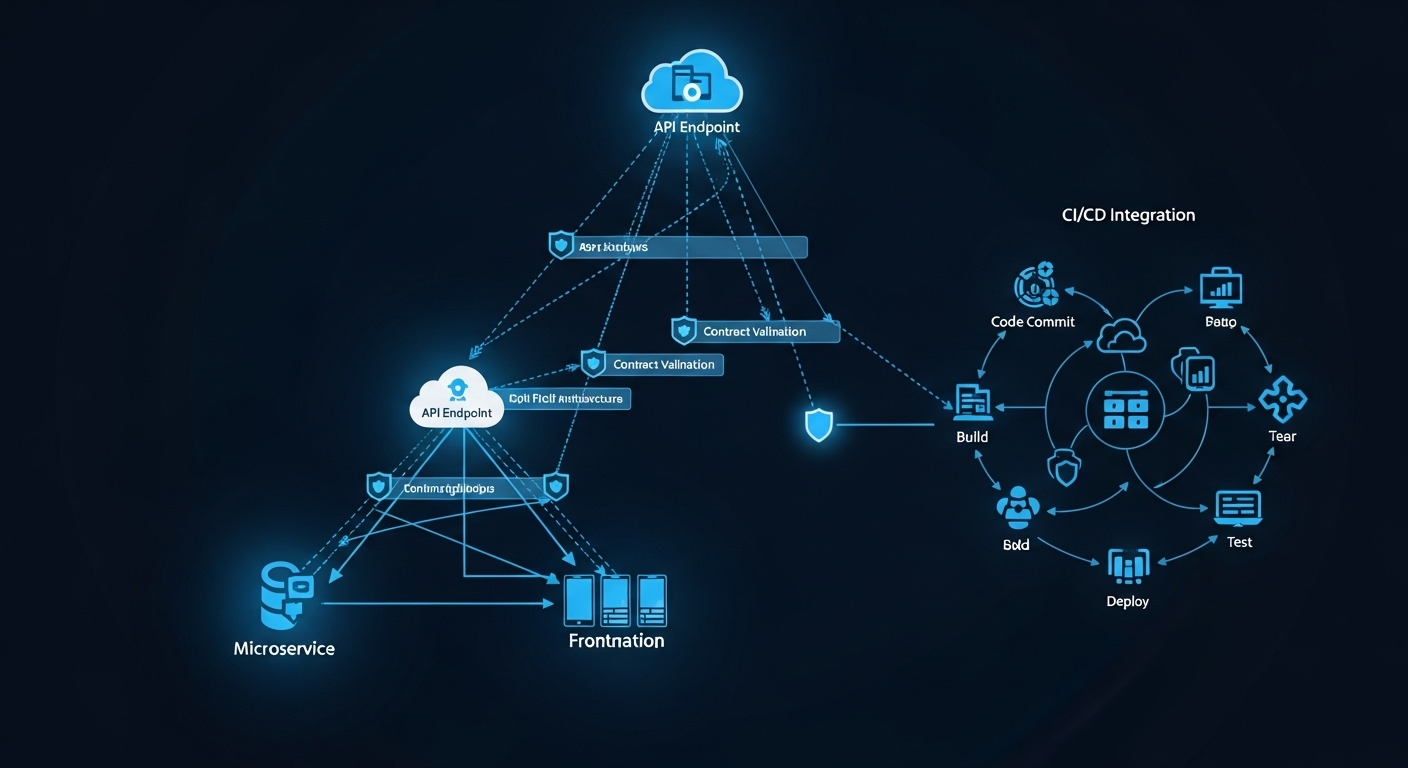
For years, quality assurance strategies revolved around user interface validation. Test automation focused heavily on clicking buttons, verifying page flows, and checking visual behavior. While UI testing still plays an important role, the center of gravity in modern quality assurance has shifted.
Today, API testing is the new core of QA.
Modern software systems are API-driven. Web applications, mobile apps, SaaS platforms, microservices architectures, and even IoT systems rely on APIs to communicate, process data, and execute business logic. If APIs fail, the entire system fails regardless of how polished the UI appears.
This structural shift has redefined how QA teams design their testing strategies.
Why APIs Have Become the Backbone of Modern Applications
Modern digital ecosystems are built on:
- Microservices architectures
- Cloud-native infrastructure
- Mobile-first applications
- Third-party integrations
- Multi-tenant SaaS platforms
In all these systems, APIs act as the communication layer between components. They handle authentication, business rules, data validation, payment processing, permissions, and integrations.
The UI is only a surface layer. The real logic lives in APIs.
Testing at the UI level alone no longer guarantees product reliability.
The Limitations of UI-First Testing
Traditional UI testing has several challenges:
- Slower execution
- High maintenance due to layout changes
- Flaky automation scripts
- Dependency on front-end stability
- Difficulty isolating root causes
When APIs are tested directly:
- Validation is faster
- Failures are easier to diagnose
- Test cases are more stable
- Coverage of business logic improves
This is why QA teams are shifting from UI-first to API-first testing strategies.
API Testing Enables Early Validation
One of the strongest advantages of it is its alignment with shift-left principles.
APIs can be tested:
- Before the UI is complete
- During development sprints
- Through mock services
- As part of CI/CD pipelines
This means QA does not need to wait for full application builds. Core functionality can be validated earlier, reducing late-stage surprises.
API testing shortens feedback loops and improves development efficiency.
Contract-Driven API Testing
Modern API testing is not limited to endpoint validation. It includes contract verification.
OpenAPI or Swagger specifications are now treated as:
- Version-controlled artifacts
- Sources of truth for system behavior
- Inputs for automated test generation
- Deployment gating mechanisms
Contract testing ensures that:
- APIs adhere to agreed structures
- Breaking changes are detected early
- Consumer-provider compatibility is maintained
This makes API validation a structural quality safeguard rather than a reactive check.
CI/CD and Continuous API Testing
Continuous integration pipelines now prioritize API tests.
Before any deployment:
- Unit tests validate code logic
- API tests validate business behavior
- Contract tests validate integration stability
- Security checks validate endpoint protection
API tests run faster than UI automation, making them ideal for gating releases.
In many organizations, API testing is now the primary release decision driver.
Security and Performance at the API Layer
APIs are exposed entry points into systems. They must be validated for:
- Authentication accuracy
- Authorization rules
- Data leakage risks
- Injection vulnerabilities
- Rate limiting behavior
Additionally, API performance testing ensures:
- Response time stability
- Throughput consistency
- Scalability under load
Security and performance are now tested directly at the API layer not just at the application surface.
The Role of Tools in Modern API Testing
Tools such as Postman, RestAssured, and Swagger have evolved from simple request-testing utilities into full automation frameworks.
Modern API testing tools support:
- Automated regression execution
- Pipeline integration
- Schema validation
- Mock server simulation
- Monitoring and observability
They allow teams to build scalable API test frameworks that align with DevOps workflows.
Observability and Production Feedback
Another major development is the integration of production data into API testing strategies.
QA teams now use:
- Production logs
- API failure patterns
- Monitoring dashboards
- Usage analytics
to refine test cases and prioritize high risk areas.
Testing is no longer disconnected from real world behavior.
Why API Testing Defines Modern QA Strategy
In 2026, API testing is not just one testing type it is the foundation of quality engineering.
API testing:
- Validates core business logic
- Enables early defect detection
- Reduces automation flakiness
- Improves CI/CD efficiency
- Strengthens integration reliability
- Enhances security posture
- Supports microservices architecture
Organizations that build API-first testing strategies deliver more stable, scalable, and resilient software products.
Forward-thinking QA service providers, including firms like QA Ninjas, prioritize API validation as a core quality discipline rather than a secondary activity.
Conclusion
API testing has moved from a supporting role to the central pillar of quality assurance. As software architectures become increasingly distributed and integration-heavy, the API layer represents the true foundation of system reliability.
UI testing validates presentation. API testing validates behavior.
In modern QA, behavior is what matters most.
Organizations that embrace API-first testing strategies gain faster feedback cycles, stronger integration stability, and higher release confidence. The future of quality assurance is API-driven and that future is already here. Let’s Discuss Contact Us