

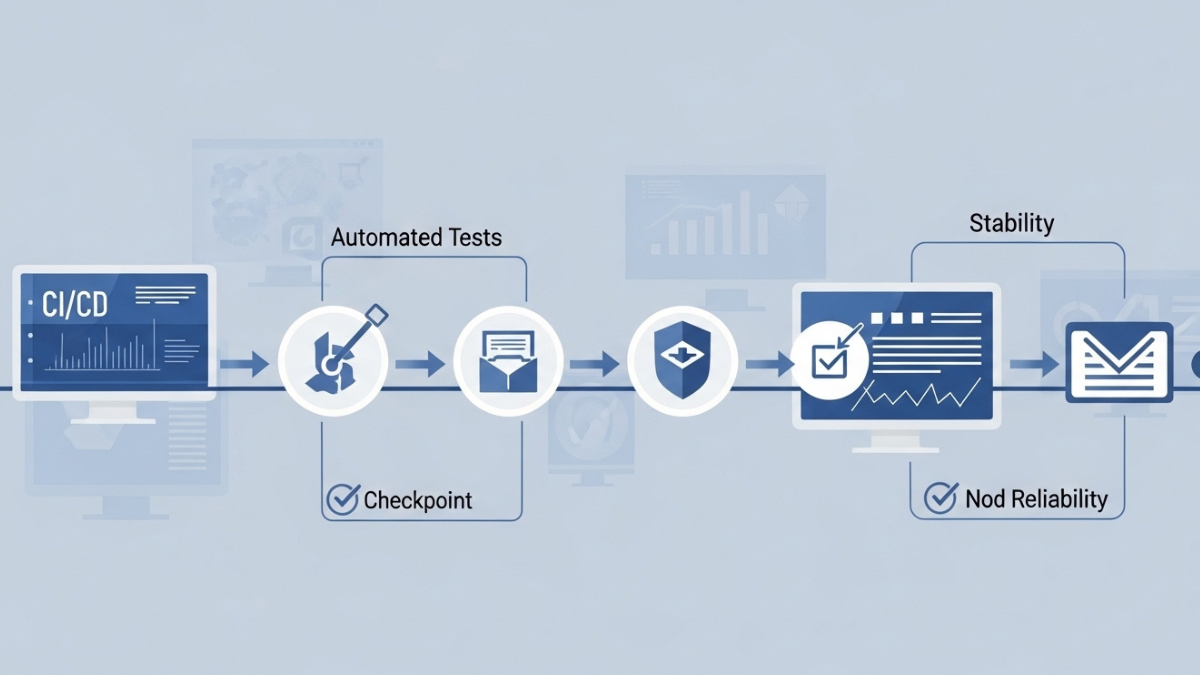
For years, automation tool selection was treated as a technical preference. Teams debated Selenium vs Cypress. Engineers advocated for Playwright. Decisions were driven by familiarity, language support, or which tool looked most modern at the time.
That era is over.
Today, automation tool choice is no longer decided by testers or developers alone. It is being decided often silently by CI/CD pipelines.
If an automation tool slows the pipeline, flakes unpredictably, or complicates deployment, it doesn’t matter how powerful it is. It will be bypassed, constrained, or eventually removed.
This shift has profound implications for how QA teams select, design, and position their automation tooling.
Table of Contents
- Introduction: The End of Tool-Centric Automation Decisions
- When Automation Became a Pipeline Bottleneck
- CI/CD Pipelines as the New Quality Gatekeepers
- Why Speed and Reliability Trump Features
- Flakiness: The Fastest Way to Kill an Automation Tool
- Headless, Stateless, Parallel: The New Baseline
- How CI/CD Is Reshaping Selenium, Playwright, and Cypress Usage
- API-First Strategies Are Reducing UI Tool Dependence
- The Death of the “One Tool Strategy”
- Automation as an Execution Layer, Not a Strategy
- What This Means for QA Leaders
- How Mature Organizations Are Adapting
- Conclusion: Pipelines Decide What Survives
1. Introduction: The End of Tool-Centric Automation Decisions
Automation was once positioned as a productivity multiplier. Write tests once, run them forever, and release with confidence. As CI/CD matured, automation became mandatory rather than optional.
But something unexpected happened.
Automation suites grew. Pipelines slowed. Flaky tests triggered false failures. Teams started rerunning builds, ignoring failures, or bypassing quality gates just to ship.
The question quietly shifted from:
“Which automation tool is best?”
To:
“Which automation tool can survive our pipeline?”
That question is now driving real-world decisions.
2. When Automation Became a Pipeline Bottleneck
CI/CD pipelines exist for one reason: fast, reliable feedback.
When automation:
- Takes too long
- Fails intermittently
- Requires manual intervention
- Breaks under parallel load
…it stops being an enabler and starts becoming an obstacle.
Many teams discovered that:
- High automation coverage didn’t equal fast feedback
- Complex UI tests delayed releases
- Automation failures were often environmental, not functional
Once this happens, leadership stops asking how many tests ran and starts asking why the pipeline is slow.
That’s the moment automation tool choice stops being a QA decision.
3. CI/CD Pipelines as the New Quality Gatekeepers
Modern pipelines enforce non-negotiable constraints:
- Limited execution time
- Stateless execution environments
- Parallel test runs
- Cloud-based runners
- Frequent execution (multiple times per day)
Any automation tool that cannot operate efficiently within these constraints is effectively incompatible regardless of its feature set.
In practice, CI/CD pipelines now act as quality gatekeepers, deciding:
- Which tests run
- When they run
- How many can run
- Which tools are tolerated
The pipeline doesn’t care about test philosophy.
It cares about speed, stability, and signal quality.
4. Why Speed and Reliability Trump Features
Tool feature comparisons used to dominate automation discussions:
- Language support
- Assertion libraries
- IDE integrations
In CI/CD-driven environments, these are secondary.
What matters most now:
- Startup time
- Execution speed
- Stability under load
- Predictable behavior in headless mode
A tool with fewer features but faster, more reliable execution will always win over a powerful tool that destabilizes the pipeline.
CI/CD rewards boring reliability, not clever capabilities.
5. Flakiness: The Fastest Way to Kill an Automation Tool
Flaky tests are no longer tolerated.
In CI/CD environments:
- A single flaky test can block multiple teams
- False failures waste engineering time
- Reruns erode trust in automation
Once trust is lost, automation becomes noise.
This is why:
- Teams aggressively remove flaky tests
- Unstable tools are constrained to nightly runs
- Some UI automation is excluded from pipelines entirely
Automation tools today are judged not by how much they can test but by how consistently they tell the truth.
6. Headless, Stateless, Parallel: The New Baseline
CI/CD pipelines assume certain capabilities by default:
- Headless execution
- Stateless runs (no reliance on previous state)
- Parallel execution at scale
- Easy cloud runner integration
Automation tools that require:
- Manual setup
- Stateful dependencies
- Long warm-up times
struggle to survive.
This environment favors tools and frameworks that were designed with pipeline-first execution in mind not desktop-first testing.
7. How CI/CD Is Reshaping Selenium, Playwright, and Cypress Usage
The shift to CI/CD-driven decisions has reshaped how popular tools are used:
Selenium
Selenium remains deeply embedded in enterprises due to:
- Legacy investments
- Broad ecosystem
- Language flexibility
However, many teams are:
- Stabilizing existing Selenium suites
- Reducing UI scope
- Moving new automation elsewhere
Selenium is no longer the default it’s the incumbent.
Playwright
Playwright benefits strongly from CI/CD constraints:
- Built-in waits reduce flakiness
- Fast execution
- Strong parallelization support
- Consistent headless behavior
As a result, it’s often chosen for new automation layers where pipeline reliability is critical.
Cypress
Cypress performs well in frontend-focused contexts but faces limitations in:
- Complex multi-domain flows
- Enterprise-scale end-to-end testing
CI/CD pressure has narrowed Cypress usage to specific scopes, rather than universal adoption.
The key point:
These tools aren’t being judged in isolation they’re being judged by pipeline performance.
8. API-First Strategies Are Reducing UI Tool Dependence
Another quiet shift driven by CI/CD is the rise of API-first automation.
Why?
- API tests are faster
- Less flaky
- Easier to parallelize
- Better suited to pipelines
As teams move logic validation to APIs, UI automation tools are increasingly used for:
- Critical user journeys
- Confidence checks
- Visual validation
This reduces the burden on UI tools and makes their pipeline compatibility even more critical.
9. The Death of the “One Tool Strategy”
CI/CD realities have exposed the weakness of “standardize on one tool” strategies.
Modern teams now accept that:
- Different layers need different tools
- No single tool excels everywhere
- Pipelines benefit from specialization
This leads to pragmatic setups:
- APIs as the backbone
- UI automation selectively applied
- Tools chosen per layer, not per ideology
CI/CD pipelines reward flexibility, not dogma.
10. Automation as an Execution Layer, Not a Strategy
One of the most important mindset shifts is this:
Automation tools are no longer the strategy.
They are execution layers.
The real strategy lives in:
- Risk assessment
- Test layering
- Pipeline design
- Feedback speed
Automation tools serve that strategy or they are replaced.
This is why tool evangelism is declining and outcome-driven QA is rising.
11. What This Means for QA Leaders
For QA leaders, this shift changes priorities:
- Tool selection must involve DevOps and platform teams
- Pipeline constraints must shape automation design
- Reliability metrics matter more than coverage metrics
- Automation must justify its pipeline cost
QA leaders who ignore CI/CD realities lose influence.
Those who align with them become strategic partners.
12. How Mature Organizations Are Adapting
Mature organizations:
- Design automation with pipeline constraints first
- Measure automation by signal quality, not volume
- Accept multiple tools as normal
- Continuously prune unstable tests
Organizations such as QA Ninjas Technologies align automation tooling decisions with CI/CD performance, release confidence, and risk reduction, rather than tool popularity or legacy bias.
This alignment is what keeps pipelines fast and quality credible.
13. Conclusion: Pipelines Decide What Survives
The most important truth in modern automation is this:
Automation tools don’t fail because they lack features.
They fail because they don’t fit the pipeline.
CI/CD has become the ultimate arbiter of quality tooling. It rewards:
- Speed
- Stability
- Predictability
- Clear signal
Anything else is noise.
The teams that understand this stop asking “Which tool is best?”
They start asking “Which tool works reliably in our pipeline?”
That question and only that question defines modern automation success. For details Contact Us