

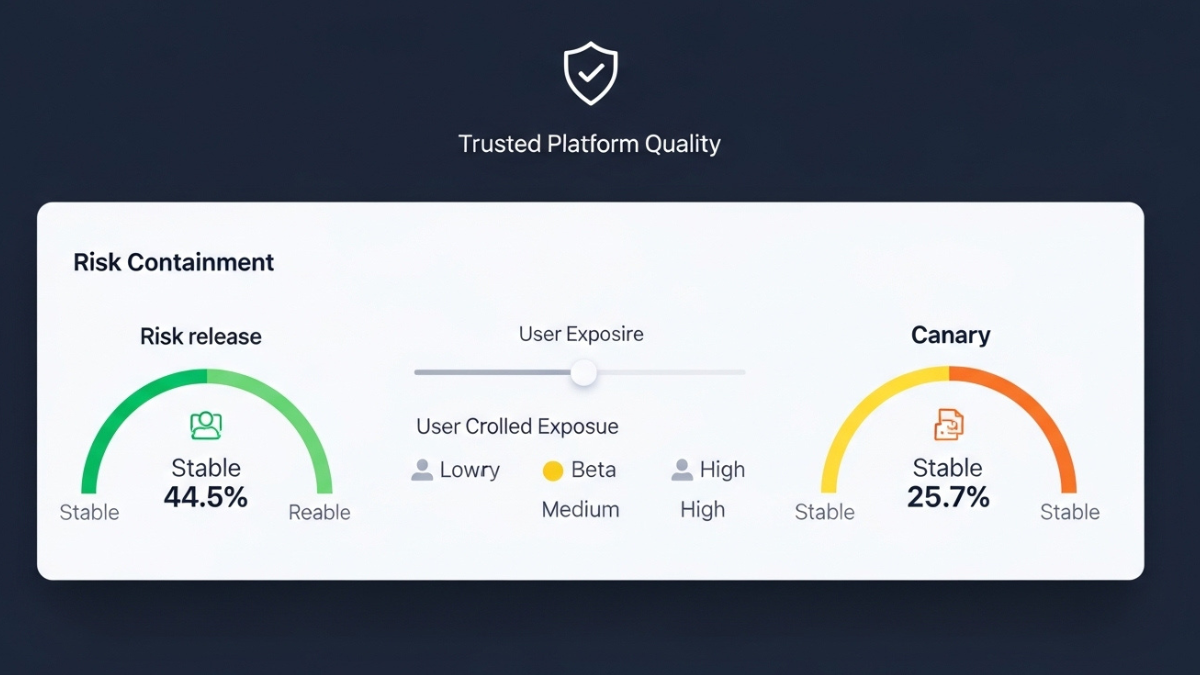
For most of SaaS history, Quality Assurance focused on a simple question:
“Does the feature work?”
In 2026, that question is no longer sufficient and often not even relevant.
Modern SaaS products don’t fail because a button is broken. They fail because rollouts go wrong: a feature flag misfires, a tenant sees something they shouldn’t, a partial deployment creates inconsistent behavior, or a rollback doesn’t behave as expected.
As SaaS platforms scale across thousands of customers, regions, and configurations, QA has quietly shifted from testing features to testing rollouts.
This is not a tooling change.
It’s a fundamental change in what “quality” means for SaaS.
Table of Contents
- Introduction: Why Feature Testing Is No Longer Enough
- The Reality of SaaS in 2026
- Why Feature-Centric QA Is Failing at Scale
- Rollouts Are Now the Real Product
- Feature Flags as a QA Responsibility
- Multi-Tenant Risk Becomes a First-Class QA Concern
- Progressive Delivery Changes What QA Must Validate
- Testing Rollback, Not Just Release
- Observability-Driven QA: Learning From Production
- Measuring SaaS QA by Business Impact
- How QA Teams Must Reorganize
- What Mature SaaS QA Looks Like in 2026
- Conclusion: QA’s New Mission in SaaS
1. Introduction: Why Feature Testing Is No Longer Enough
Traditional QA asks:
- Does the feature meet requirements?
- Does it work in isolation?
- Does it pass regression?
SaaS QA in 2026 asks:
- Who will see this feature?
- When will they see it?
- What happens if it partially fails?
- Can we safely roll it back?
The shift is subtle but decisive.
Software as a Service products are no longer shipped as “releases” — they are continuously exposed through controlled rollouts.
And QA must follow that reality.
2. The Reality of SaaS in 2026
Modern Software as a Service platforms operate under conditions that didn’t exist a decade ago:
- Continuous deployment
- Feature flags everywhere
- Multi-tenant architectures
- Region-specific configurations
- Enterprise SLAs
- Always-on customers
In this environment:
- There is no single “release moment”
- There is no single “production state”
- There is no single “user experience”
QA that only validates features in a staging environment is testing a version of the product that no real customer will ever use.
3. Why Feature-Centric QA Is Failing at Scale
Feature-centric QA assumes:
- One version of the product
- One deployment state
- One user experience
Software as a Service reality breaks all three assumptions.
Common enterprise Software as a Service failures today are not feature bugs — they are exposure bugs, such as:
- A feature enabled for the wrong tenant
- A flag turned on without required dependencies
- Partial rollout causing inconsistent UI/API behavior
- Rollback restoring code but not configuration
Feature tests pass.
Customers still experience failures.
That gap is where modern SaaS QA lives.
4. Rollouts Are Now the Real Product
In 2026, how a feature is released matters more than the feature itself.
Rollouts include:
- Feature flags
- Canary deployments
- Gradual tenant exposure
- Region-based activation
- Role-based enablement
From a customer’s perspective, the rollout is the product.
QA must now validate:
- Correct flag combinations
- Safe exposure sequencing
- Dependency readiness
- Rollout failure behavior
Testing a feature without testing its rollout is incomplete QA.
5. Feature Flags as a QA Responsibility
Feature flags were once a developer convenience.
In 2026, they are a QA risk surface.
Modern SaaS QA explicitly tests:
- Flag on / off behavior
- Flag dependency conflicts
- Partial flag exposure
- Flag cleanup and retirement
- Flag behavior during rollback
Unchecked flags are one of the largest sources of:
- Production inconsistency
- Tenant-specific bugs
- “Works for me” failures
QA teams that don’t test feature-flag logic are effectively blind to real-world SaaS behavior.
6. Multi-Tenant Risk Becomes a First-Class QA Concern
Enterprise Software as a Service failures are rarely universal.
They are tenant-specific.
QA in 2026 must validate:
- Tenant isolation
- Data separation
- Permission boundaries
- Custom configuration impact
- Feature availability per tenant
A bug that affects one enterprise customer can:
- Trigger escalations
- Breach SLAs
- Damage platform credibility
This is why multi-tenant risk testing is now a core SaaS QA competency, not an edge case.
7. Progressive Delivery Changes What QA Must Validate
Progressive delivery means:
- Not all users see the same thing
- Not all failures appear immediately
- Not all rollouts succeed uniformly
QA must now test:
- Canary behavior under load
- Partial rollout recovery
- Rollout pause and resume
- Impact of delayed exposure
The question is no longer:
“Does the release work?”
It is:
“Does the rollout fail safely?”
That distinction defines modern SaaS quality.
8. Testing Rollback, Not Just Release
One of the most dangerous assumptions in SaaS is:
“We can always roll back.”
In reality:
- Configurations persist
- Data migrations don’t reverse cleanly
- Feature flags may not reset
- Users may already be impacted
Modern SaaS QA explicitly tests:
- Rollback scenarios
- Rollback completeness
- Rollback side effects
- Post-rollback system state
If rollback is untested, it is wishful thinking, not a safety net.
9. Observability-Driven QA: Learning From Production
Software as a Service QA is no longer isolated to pre-production environments.
In 2026, QA teams actively use:
- Production logs
- Metrics
- Traces
- Real user behavior
This allows QA to:
- Identify real failure patterns
- Design regression tests from incidents
- Validate fixes against real data
- Detect rollout risk early
QA becomes production-aware, not production-blind.
10. Measuring SaaS QA by Business Impact
Traditional QA metrics don’t work for Software as a Service scale.
Modern SaaS QA is measured by:
- Customer escalations avoided
- SLA breaches prevented
- Incident frequency reduction
- Rollout confidence
- Tenant trust preserved
Executives don’t ask:
- “How many tests ran?”
They ask:
- “Did this rollout hurt customers?”
QA reporting must answer that question clearly.
11. How QA Teams Must Reorganize
This shift requires structural change.
High-maturity SaaS QA teams:
- Embed QA in product and platform teams
- Participate in rollout planning
- Influence feature-flag strategy
- Collaborate with DevOps and SRE
- Own quality gates for exposure, not just code
QA moves from:
testing after development → governing release behavior
12. What Mature SaaS QA Looks Like in 2026
Mature Software as a Service QA organizations:
- Test rollouts as first-class artifacts
- Treat feature flags as risk surfaces
- Validate tenant-level exposure
- Use observability as a testing input
- Measure success by business stability
Organizations like QA Ninjas Technologies align Software as a Service QA strategies around rollout safety, tenant risk, and release confidence, not just feature correctness.
This is how QA scales with SaaS growth without slowing it down.
13. Conclusion: QA’s New Mission in SaaS
SaaS QA in 2026 is not about finding more bugs.
It is about ensuring:
- The right users see the right features
- At the right time
- In the right way
- With a safe exit when things go wrong
Features are only half the story.
Rollouts are where SaaS products live or die.
QA teams that adapt to this reality become strategic enablers.
Those that don’t become irrelevant — no matter how many tests they run.
The future of SaaS QA belongs to teams that understand one simple truth:
Quality is no longer about what you build.
It’s about how you release it. Let’s Discuss at Contact Us